How I Teach It: Teaching Black Feminism Using Digital Games
In this series we celebrate and discuss the ways that scholars around campus teach complex gender and women's studies concepts like feminisms, gender, sex, and intersectionality among others.
Dr. Kishonna Gray is an Associate Professor of Writing, Rhetoric, & Digital Studies and Africana Studies at the University of Kentucky. She is also a faculty associate at the Berkman-Klein Center at Harvard University.
Dr Gray is the author or co-editor of numerous books and articles including her foundational 2014 work Race, Gender, & Deviance in Xbox Live: Theoretical Perspectives from the Virtual Margins, 2018’s edited collections Woke Gaming and Feminism in Play (University of Washington press) and most recently Intersectional Tech: Black Users in Digital Gaming. She also has a book currently under contract with NYU Press entitled Black Game Studies.
She’s a highly sought after speaker and regularly addresses both academic and industry audiences such as at the Game Developers Conference. She is the winner of a number awards over the years including The Evelyn Gilbert Unsung Hero Award and the Blacks in Gaming Educator Award.
Dr. Frances Henderson, Associate Professor of GWS and AAAS at UK will interview Dr. Gray.


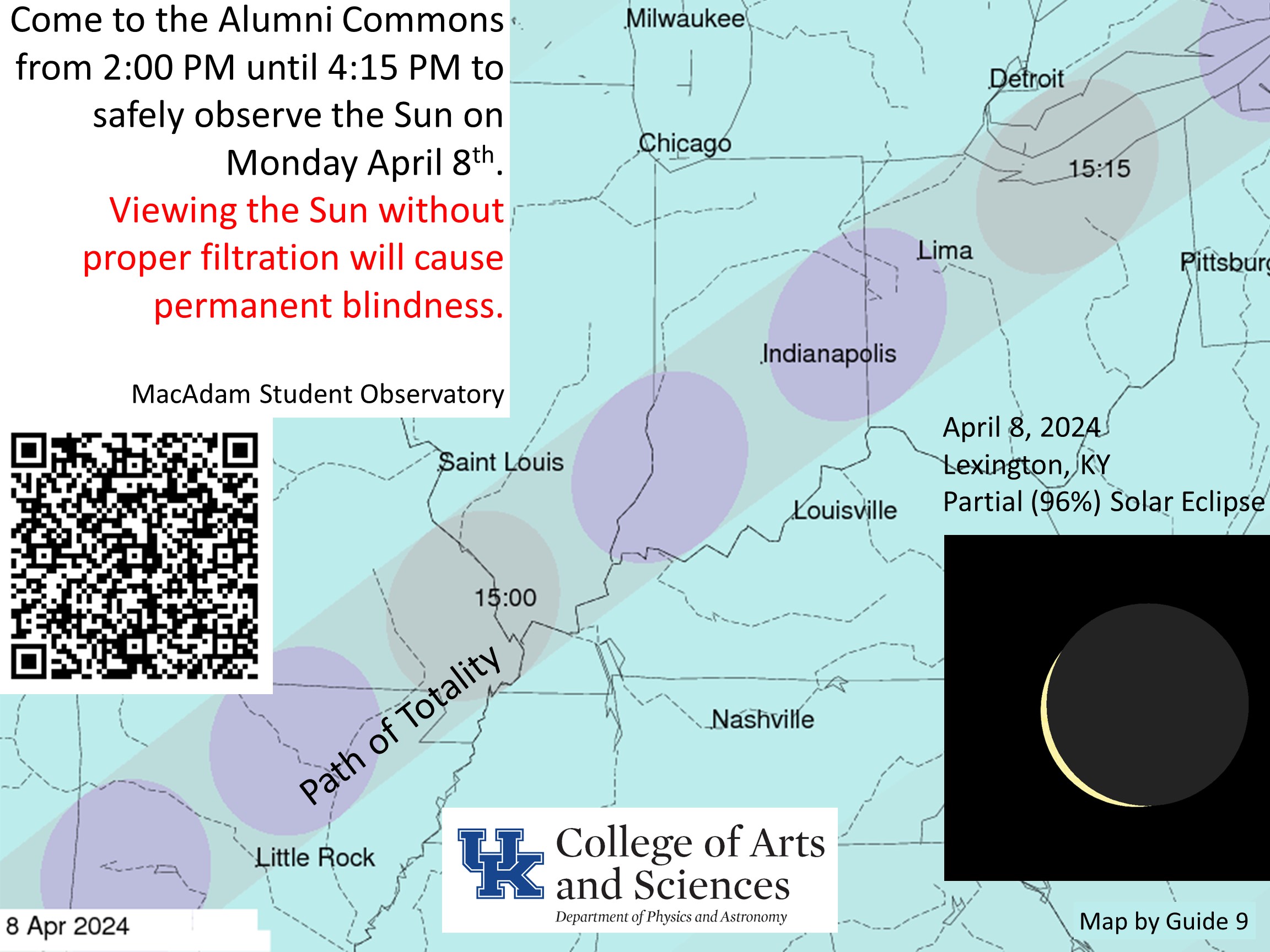 The goal of every eclipse chaser should be to get to a clear spot within the path of totality. The closer to the center of the path, the longer totality will last. A totally eclipsed Sun is a visual experience like no other. There is a crown of light surrounding the Sun that is a million times dimmer than the Sun’s surface. It cannot be observed while any part of the surface is uncovered. No one can predict in advance what it will look like; each eclipse is unique.