
The Kick Start: Meet & Greet with AAAS

Date:
-
Location:
MLK Center Multi-Purpose Room - Gatton Student Center (GSC A230 MLK)
By Richard LeComte
LEXINGTON, Ky. -- Two recently added bachelor’s degree programs in the University of Kentucky’s College of Arts and Sciences have drawn students with passions for the law and statistics.
Dr. Matthew Bayliss, University of Cincinnati
Title: Taking Galaxies Apart and Putting Them Back Together Again
Abstract: Understanding the growth and evolution of stars and galaxies across cosmic time is a cornerstone of modern observational cosmology. After Cosmic Dawn, the first generation of galaxies powered much of cosmic re-ionization. Later, the global star-formation density accelerated toward its peak at Cosmic Noon, when most of the stellar mass in the Universe was formed. The industry standard is to use individual galaxies as the de facto measurement unit. There are practical reasons for counting galaxy-by-galaxy: galaxies grow and reside in dark matter haloes that map back to primordial mass over-densities, and even space-based observatories can only marginally resolve galaxies in the distant universe. However, the physical processes that drive galaxy growth and evolution -- cloud collapse, star formation, feedback, etc. -- operate on scales much smaller than a galaxy. I will present ongoing work using bright, strongly lensed galaxies to zoom in on the scales of individual star clusters to resolve the physics of what's happening inside distant galaxies.
Title: From chiral effective field theory to perturbative QCD: A Bayesian model mixing approach to neutron star matter
Abstract: Constraining the equation of state (EOS) of strongly interacting, dense matter is the focus of significant experimental, observational, and theoretical effort. While chiral effective field theory (EFT) can describe the EOS between the typical densities of nuclei and those in the outer cores of neutron stars, perturbative QCD (pQCD) can be applied to properties of deconfined quark matter, both with quantified theoretical uncertainties.
However, describing the full range of densities in between with a single EOS that has well-quantified uncertainties is a challenging problem. Bayesian model mixing (BMM) can help bridge the gap between the two theories.
In this talk, I will present a BMM framework that can combine EOS constraints from different density regions in a principled way to construct a globally predictive, composite EOS model based on Gaussian processes (GPs). I will discuss applications of this BMM framework to the EOS and structure of neutron stars, as well as the statistical uncertainty quantification of the underlying microscopic EOS calculations.
LEXINGTON, Ky. (Aug. 26, 2025) — Fiction has long offered writers a veil — an opportunity to tell deeply personal stories at a safe distance.
But what happens when that veil is intentionally thin, when the line between fact and imagination is not simply blurred but deliberately twisted?

Title: Some results from my research career and recent work on a sample size problem for free-ranging wildlife.
Abstract: I will begin by briefly discussing some aspects of my Ph.D. dissertation and research at the University of Kentucky, which focused on an estimation technique for Markov processes. I will then review results from three papers I have co-authored involving, respectively, an epidemic model, the double bootstrap and generalized linear mixed models.
The main part of my talk concerns a recently proposed two-parameter model and a Bayesian statistical framework for estimating prevalence and determining sample size requirements for detecting disease in free-ranging wildlife. Well-known sample size formulas assume that animals contract disease independently, an assumption that is unlikely to hold in many practical settings. The presence of correlation has implications for sample size requirements and sampling design.
Booth et al. (2023) “Sample size for estimating disease prevalence in free-ranging wildlife populations: a Bayesian modeling approach”, Journal of Agricultural, Biological and Environmental Statistics, 29(3):438-454
Booth et al. (2025) “Management agencies can leverage animal social structure for wildlife disease surveillance”, Journal of Wildlife Diseases, 61(2):472-476
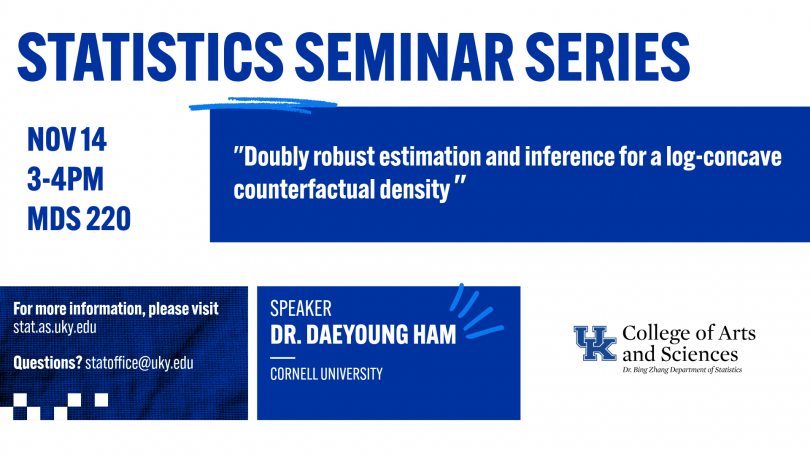
Title: Doubly robust estimation and inference for a log-concave counterfactual density
Abstract: We consider the problem of causal inference based on observational data (or the related missing data problem) with a binary or discrete treatment variable. In that context, we study inference for the counterfactual density functions and contrasts thereof, which can provide more nuanced information than counterfactual means and the average treatment effect. We impose the shape-constraint of log-concavity, a type of unimodality constraint, on the counterfactual densities, and then develop doubly robust estimators of the log-concave counterfactual density based on augmented inverse-probability weighted pseudo-outcomes. We provide conditions under which the estimator is consistent in various global metrics. We also develop asymptotically valid pointwise confidence intervals for the counterfactual density functions and differences and ratios thereof, which serve as a building block for more comprehensive analyses of distributional differences.
Title: Scalable distributional regression for wearable devices, adjusting for informative non-wear bias (plus hybrid statistical-AI generative models for complex structured data)
Abstract: Many modern instruments (wearables, imaging, geospatial sensors) generate subject-level data streams with thousands to millions or more measurements. Collapsing these to simple summaries (e.g., means) can obscure important structure. We present a general distributional regression framework for distribution-on-scalar and distribution-on-function settings. Distributions are modeled via subject specific empirical quantile functions and represented with quantlet basis functions that provide a compact and near-lossless representation for the subject-specific distributions, enabling joint inference on entire distributions and flexible post hoc computation of any distributional summary to characterize the differences.
Our approach is built on the Bayesian Functional Mixed Model (BayesFMM) framework, accommodating arbitrary mixes of discrete/continuous predictors with smooth (nonlinear) effects, multiple random-effects levels for multilevel designs, nonstationary spatial/temporal dependence, and Gaussian or heavier-tailed errors for robustness. A basis-projection strategy makes the method computationally scalable in both the number of subjects and the number of repeated measurements per subject. Simulation studies show greater efficiency than fitting separate models over a grid of quantiles.
To address informative missingness, we incorporate functional predictors that encode time-of-day non-wear patterns, effectively calibrating each subject’s distribution to a common non-wear profile. Simulations demonstrate that non-wear biases both full-distribution inference and scalar summaries, and we show that our proposed regression calibration approach mitigates this bias more effectively and much more computationally efficiently than imputation.
Applied to the TEAN adolescent accelerometer study, we confirm and refine associations of adolescent activity levels with age, BMI, and walkability, characterizing nuanced effects for these continuous predictors, and identifying which parts of the activity distribution shift without predefining summaries.
Time permitting, I will briefly preview ongoing work using statistical generative AI to build inferential frameworks for complex object data while preserving key internal structure, with application to handwritten digits data, and show how both the distributional regression for wearable devices and generative AI model for digits data are encompassed by one general methodological framework.
Title: QED correction to neutron beta decay
Abstract: The neutron lifetime is a key precision observable for testing the Standard Model (SM). A deviation from its predicted value would constitute a clear signal of physics beyond the SM. This talk will briefly review the background of neutron beta decay with a focus on the Fermi function.
Traditional calculations of the Fermi function are typically restricted to high-$Z$ (atomic number) and small-$\beta$ (velocity) regimes. We introduce a new formalism, deriving a Quantum Field Theory (QFT) analog of the Fermi function that is valid for the low-$Z$ and large-$\beta$ region relevant to neutron decay.
We will discuss the factorization of this formalism and compute the components of the factorization formula. Furthermore, we will address the resummation and convergence of the associated perturbation theory. Finally, we combine these results to calculate a novel QED correction to the neutron lifetime. We use this updated correction to derive a new, high-precision value for the CKM matrix element $|V_{ud}|$
Title: Overview of the Edwards Accelerator Laboratory and recent activities
Abstract: Ohio University’s Edwards Accelerator Laboratory (EAL) houses a 4.5-MV tandem Pelletron accelerator with six beamlines dedicated to low-energy nuclear science and materials science capabilities. The facility can deliver intense charged particle beams in either direct current or pulsed mode with nanosecond time resolution. End stations include multiple fixed and moveable detection systems for charged particles and gamma rays to study reactions of interest for nuclear structure, nuclear astrophysics, and materials characterization. The laboratory has decades of experience in the production and detection of quasi-monoenergetic and broad-spectrum neutrons up to about 24 MeV for basic science and applications with two beamlines dedicated primarily to neutron work. This talk will give an overview of the EAL, including more detailed descriptions of the neutron production capabilities and characterization methods, highlight recent publications from work conducted in the lab, and describe synergistic activities, including undergraduate research.